South Livermore Homes Cost Twice as Much. The Square Footage Costs the Same.
"These amendments are critical to the long-term success of Livermore Valley's wine industry and the local economy," Tri-Valley Conservancy executive director Rebecca Spector said when Alameda County loosened land-use rules for the area's vineyard preserve last year. It read like routine planning language. It was actually a clue to something most buyers comparing Livermore neighborhoods never think to ask: why does a home a few minutes south of downtown cost more than double what the rest of the city pays, without costing more per square foot?
Over the three months ending June 2026, the median sale price in South Livermore was $2.3 million. Citywide, Livermore's median for the same window was $1.1 million. That's the gap everyone notices. Here's the part that doesn't fit the story buyers tell themselves about why: the median price per square foot in South Livermore was $654 during that stretch. Citywide, it was also $654. Homes in the two areas sell for the same rate per square foot. The entire premium is land, not finish level, not fixtures, not a fancier build. And the reason that land carries a permanent premium traces back to a single planning rule written in 1993, long before anyone touring Ruby Hill or Vineyard Estates today was in the market.
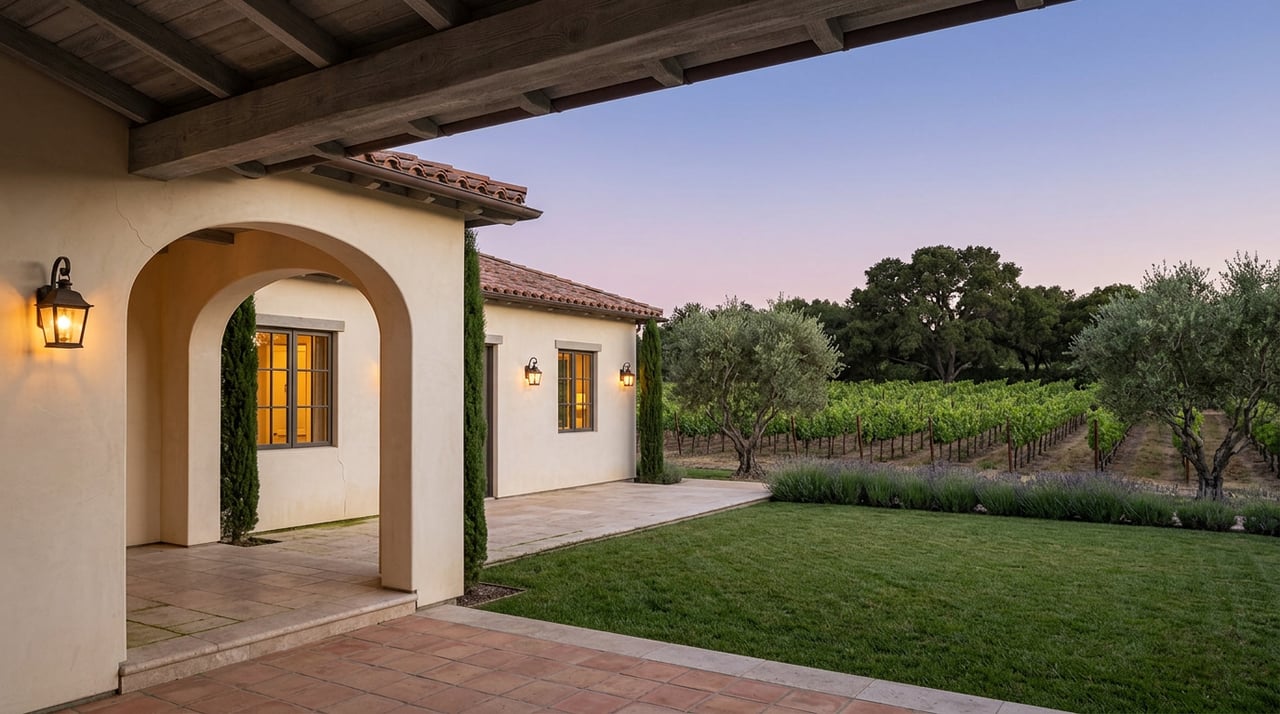
South Livermore's vineyard views aren't landscaping. They're a zoning requirement. The South Livermore Valley Specific Plan, adopted by the city in the early 1990s to guide development along a 1,891-acre unincorporated stretch of the city's southern edge, ties every new home in that district to an acre of new vineyard. Under the plan's mitigation program, developers building in South Livermore had to plant one acre of new vineyard, or another appropriate cultivated crop, for every acre of land urbanized, and one acre for every new home constructed. That acreage doesn't sit as decoration. It has to be placed under a permanent agricultural easement, and developers were required to show an eight-year or longer maintenance contract to prove the vines would actually be cared for, not planted once for the photos and abandoned.
That's why Ruby Hill, Vineyard Estates at Ruby Hill, and the homes along the Vineyard Avenue corridor look and feel nothing like a standard Livermore tract subdivision. The vineyards ringing those neighborhoods aren't a developer's amenity choice. They're a legal condition of the entitlement, recorded against the land, that no future owner or HOA board can vote to develop away. Fenestra Winery, established on the historic Ruby Hill property by the Replogle family, and Ruby Hill Winery, less than a mile beyond the neighborhood's gates, are the visible edge of that requirement. The plan capped the district at roughly 1,221 single-family detached homes across about 487 of its 1,891 acres, and county planning materials indicate that nearly all of those approved homes have already been built. There is no meaningful path to more supply inside that boundary. The vineyard backdrop, and the scarcity that comes with it, was fixed by design more than three decades ago.
| South Livermore | Livermore (citywide) | |
|---|---|---|
| Median sale price (3 mo. ending June 2026) | $2.3M | $1.1M |
| Median price per square foot | $654 | $654 |
| Average days on market | 12 days | 13 days |
| Redfin Compete Score | 89 / 100 | 86 / 100 |
| Homes sold, June 2026 | 23 | 248 |
Set the price row aside for a moment and look at the rest of the table. Pace is nearly identical. Competitiveness scores are nearly identical. If South Livermore were simply a hotter pocket of an already hot market, you'd expect it to sell faster and tighter than the rest of the city. It doesn't, meaningfully. What it does is sell for more than double, at the exact same rate per square foot. That combination only makes sense if buyers aren't paying for a better house. They're paying for more of an irreplaceable input: land that comes wrapped in a permanent vineyard easement that cannot be subdivided, redeveloped, or expanded to meet future demand.
For context on what that scarcity can mean at the top of the market, the Concannon Vineyard estate, a legacy Livermore Valley property, reportedly sold in late 2024 for $17.9 million, a figure that included winery assets and brand value beyond the land itself. It isn't a clean residential comp, but it signals how much premium the valley's largest, most established vineyard holdings can command when they do change hands.
The vineyard-view subdivisions inside the city's plan are built out and locked in. The larger, still-agricultural preserve surrounding them, the unincorporated South Livermore Valley Area Plan that Alameda County oversees, is a different and still-evolving story. In May and June of 2025, the county's Board of Supervisors approved amendments to the East County Area Plan that make it easier to build visitor-serving businesses on that land. The changes allow property owners to cluster buildings on larger ag-zoned parcels and add conditional uses including tasting rooms, inns, and food and beverage stores. Within each 20-acre increment of a qualifying parcel, an owner is now entitled to one homesite, one two-acre building envelope, and up to 20,000 square feet of visitor-serving commercial space, with the county permitting a net increase of 150,000 square feet of new commercial space across the vineyard area overall.
None of that changes what already exists inside Ruby Hill's gates. It does mean the working agricultural land just beyond those built neighborhoods is being repositioned for more wine tourism activity: tasting rooms, small inns, event space. County planning staff determined the amendments didn't trigger a ballot vote because they left intact the protections established by Measure D, the 2000 county measure aimed at preserving agricultural land from poorly located development. For an owner or buyer near that boundary, it's worth understanding whether a given parcel sits inside the built-out, already-easemented subdivisions or within the surrounding preserve where new commercial activity is now easier to approve.
A buyer weighing a standard Livermore subdivision against something in the South Livermore vineyard zone is really choosing between two different kinds of scarcity. Elsewhere in the city, new construction can still add supply over time. Inside the vineyard district, it structurally cannot. That permanence is what the price premium is compensating for, not a higher-end kitchen or a longer builder warranty.
A short list worth working through before writing an offer in this area:
Does every home in Ruby Hill or Vineyard Estates sit on easemented vineyard acreage? Not every lot backs directly to vineyard, but the surrounding acreage across the district was planted and easemented as a condition of the original development approval, which is why the setting reads as consistent even where individual lots vary.
Will the 2025 county amendments bring more traffic or tasting rooms near existing homes? The amendments apply to the surrounding unincorporated agricultural preserve rather than the already-built subdivisions, but they do make it easier for large ag parcels near that boundary to add visitor-serving uses, which is worth asking about if a property sits close to undeveloped acreage.
Is the price gap between South Livermore and the rest of the city likely to close? Nothing in the current zoning framework points that direction. The district's home count was capped by the original plan and is largely built out, and the land use rules that keep the vineyard acreage intact were designed to be permanent rather than temporary.
Comparing neighborhoods on price alone misses the mechanism that actually sets it. If you're weighing a move into Livermore's vineyard district, or trying to price a home you already own there, the underlying zoning history matters as much as the comps. Heather MacFarland works across the Tri-Valley with exactly this kind of detail in mind. Let's Connect.

Heather MacFarland is an experienced real estate agent with a passion for providing white-glove, concierge services to every client she represents.
Heather MacFarland | CA DRE# 02141113 | Elation Real Estate
127 Spring St Ste 230 Pleasanton, CA 94566