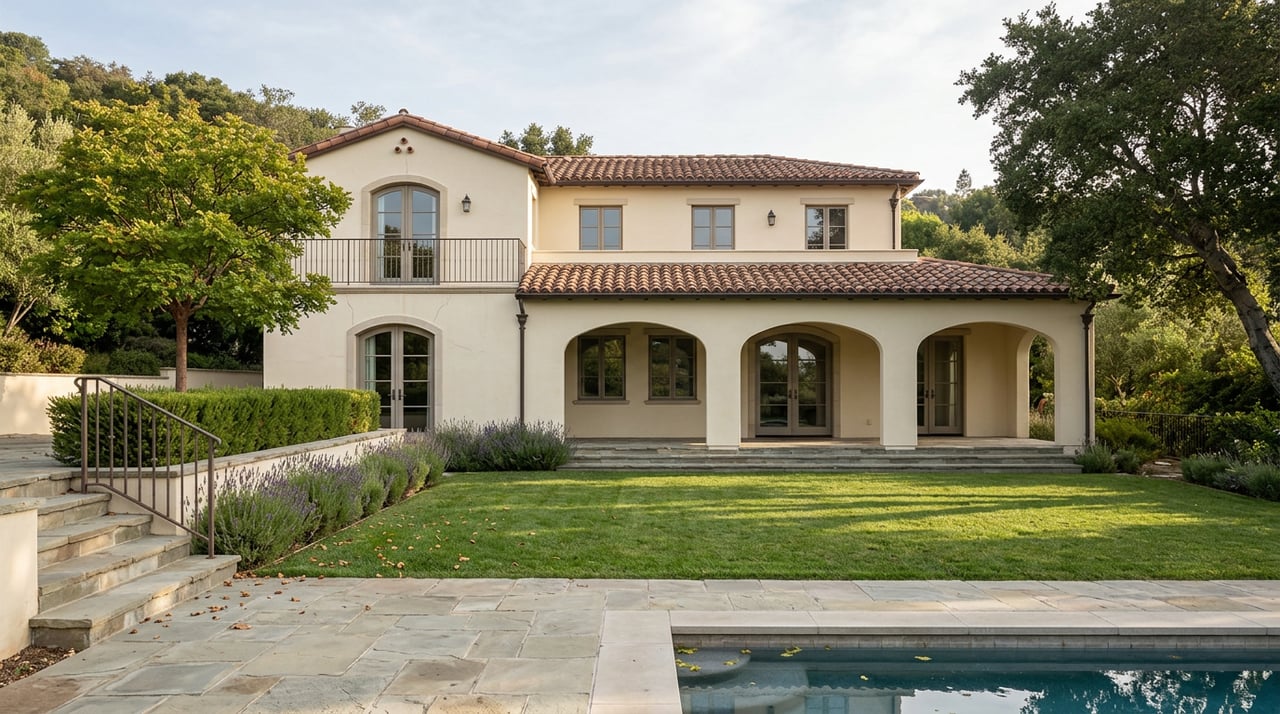
Gale Ranch vs. Windemere: San Ramon Cost Comparison
A buyer touring Windemere sees the absence of a monthly HOA invoice and reads it as savings. A buyer touring Gale Ranch a half mile away sees the HOA line item and assumes the opposite. Both readings are wrong, and the reason why says something useful about how master-planned San Ramon actually prices out.
Gale Ranch has a traditional homeowners association. Windemere does not. That much is accurate. What it does not tell you is which one costs more to own, because "no HOA" in Dougherty Valley rarely means no charge. It usually means the charge moved somewhere less visible: onto the county property tax bill itself.
Start with Gale Ranch, since it's the community buyers assume is pricier because it has a governing association. The Communities of Gale Ranch, which spans seven neighborhoods (Avanti, Belvedere, Coronado, Gallery, Monarch, Solaire, and Terravista), runs on annual dues of $205 for 2026, according to the association's own published FAQ. That's not a typo and it's not monthly. It's the full-year charge, covering common-area landscaping, a shopping center anchor, and the parks and trails woven through the flatter, more open layout that defines this side of the valley.
For context, plenty of Bay Area HOAs run $200 to $400 a month. Gale Ranch's entire annual bill lands under what a lot of associations charge in six weeks. If a buyer is discounting Gale Ranch because "it has an HOA," they're pricing in the wrong number.
Windemere, the more hillside, view-oriented side of Dougherty Valley, was built under a different financing model entirely. Instead of an association collecting dues, Windemere's infrastructure, streets, parks, and public improvements were funded through a Community Facilities District, which shows up on the property tax bill as a Mello-Roos special tax rather than a separate monthly invoice from a management company.
That distinction matters because a CFD special tax isn't capped the way California's Proposition 13 caps the base 1% property tax rate. Mello-Roos is a fixed, bond-backed assessment tied to the parcel, not the home's assessed value, and it doesn't max out at a friendly annual figure the way Gale Ranch's dues do. It's collected in two installments alongside the regular county tax bill, which is exactly why it's easy to miss when a buyer is comparing sale prices instead of full tax bills.
Windemere still delivers what the HOA fee buys elsewhere. The Windemere Ridge Trail and Rolling Hills Trail run right off the neighborhood near Windemere Ranch Middle School, and the larger lots and three-car-garage floor plans common to its late-1990s and early-2000s construction reflect the era's buyer expectations. The tradeoff isn't quality. It's collection method, and collection method is exactly what a listing sheet doesn't show you.
| Cost Mechanism | Gale Ranch | Windemere |
|---|---|---|
| Governing structure | Traditional HOA, CC&R-governed | Community Facilities District (CFD) |
| How it's billed | Annual HOA dues ($205 in 2026) | Mello-Roos special tax on property tax bill |
| Cap on annual increases | Set by HOA board and reserve study | Set by the CFD's Rate and Method of Apportionment, not Prop 13 |
| Applies regardless of side | Dougherty Valley GHAD assessment on both |
There's a third charge that neither an HOA fee nor a Mello-Roos bill fully explains, and it applies to Gale Ranch and Windemere alike. The Dougherty Valley Geologic Hazard Abatement District, run by the City of San Ramon with the City Council sitting as its board, manages roughly 2,767 acres of open space across West Branch, Old Ranch Summit, and the Dougherty Valley footprint. Every property inside those boundaries pays an annual GHAD assessment that funds hillside monitoring, drainage, and slope stabilization work, the kind of maintenance that becomes visible only when something goes wrong.
It has gone wrong before. In 2019 the GHAD removed roughly 103,700 cubic yards of material to stop a slow-moving landslide east of Kami Court, then installed hydraugers, perforated drain pipes bored into the hillside, to keep groundwater from restarting the slide. That's the kind of work the assessment is quietly funding every year, on both sides of the valley, whether your neighborhood has an HOA or a CFD layered on top of it.
Zoom out to the ZIP code level and the pattern holds. San Ramon's median effective property tax rate runs around 1.25%, but that figure hides a real spread within the city itself: homes in ZIP code 94582 carry a median effective rate of 1.31%, while 94583 sits at 1.19%, according to property tax data from Ownwell. A 0.12 percentage point gap sounds small until you're comparing two homes at the same price point and realizing one carries a meaningfully higher annual bill purely because of which special districts stack on that parcel.
That stacking is the real friction point. Multiple Dougherty Valley parcels carry more than one overlapping CFD at once, meaning the Mello-Roos line on a Windemere tax bill isn't always a single number you can look up by neighborhood name. It has to be read off the specific parcel's tax bill or preliminary title report, because two homes on the same street can carry different combinations of districts depending on which phase of development they belong to.
The math compounds as home values rise. At the $2 million-plus tier, where Gale Ranch's upper inventory and Norris Canyon Estates both compete for buyers, combined HOA and CFD obligations can add somewhere in the range of $800 to $1,200 or more per month on top of the mortgage payment. That's not a rounding error in a monthly budget, and it doesn't shrink just because the purchase price is larger.
It's also where the comparison to Danville becomes useful. Danville's high end tends toward established estates on larger, older lots, typically without any Mello-Roos obligation at all, trading San Ramon's newer construction and current school district assignments for simpler, more predictable carrying costs. Neither city wins outright. They're solving the same affordability question with different tools, and a buyer who only compares purchase price is missing the tool entirely.
Does a lower HOA fee mean lower total housing cost? Not on its own. Gale Ranch's HOA dues are unusually low, but the total monthly obligation still depends on the base property tax rate, any CFD assessments layered on top, and the GHAD charge. All of it has to be added together, not compared fee by fee.
Is Mello-Roos permanent? No. CFD special taxes end once the underlying bonds are paid off, typically 20 to 40 years after issuance, though the exact end date varies by district and has to be confirmed per parcel.
Does the GHAD assessment ever go away? It's tied to ongoing hillside monitoring and reserve funding for larger repairs, so it functions as a standing cost of owning inside the district rather than a temporary charge with a fixed end date.
If you're comparing Gale Ranch, Windemere, or any other Dougherty Valley subdivision and want the actual tax bill, HOA budget, and CFD terms pulled for a specific address before you write an offer, that's exactly the kind of homework Heather MacFarland does before a client ever sees a comp sheet. Let's Connect.

Heather MacFarland is an experienced real estate agent with a passion for providing white-glove, concierge services to every client she represents.
Heather MacFarland | CA DRE# 02141113 | Elation Real Estate
127 Spring St Ste 230 Pleasanton, CA 94566